
Opinion
Insecurity Reveals Gaps in Security Coordination

|
Getting your Trinity Audio player ready...
|
Insecurity reveals gaps in security coordination.
By Abba Dukawa
The issue of insecurity in Nigeria has become a grave concern for all citizens, many of whom wonder how the country arrived at a situation where no one feels safe. Today, especially the downtrodden feel insecure; in one moment there is reason to smile, and in the next only hopeless tears for the security failure.
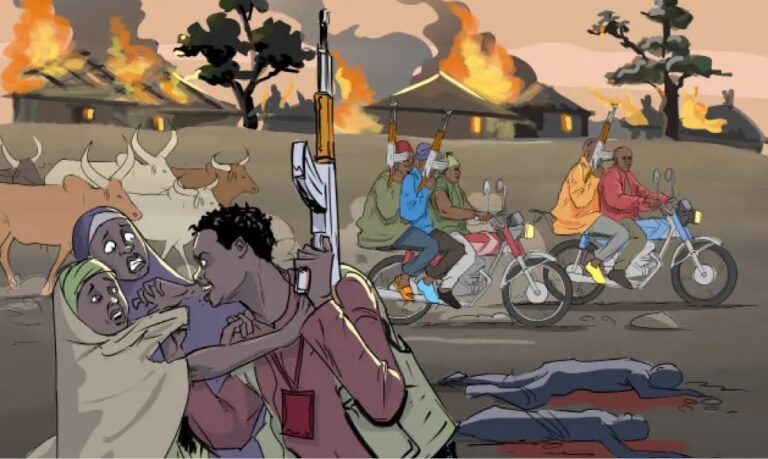
In recent days the country has witnessed its bloodiest day, unleashed by terrorists and bandits against defenseless people. In the northeast, terrorists abducted and publicly executed Brigadier General Uba and three of his men in Borno State. Eight members of the Civilian Task Force were killed and three were abducted in Gwoza, Borno State; in Tsafe LGA, Zamfara State, 64 civilians—including women and children—were abducted.
In Maga, Kebbi State, 25 female students and their principal were taken from a school, while the vice‑principal was killed. In Eruku, Kwara State, 38 worshippers were abducted from a church, and a policeman was killed in an attack in Geidam, Yobe State. Fifteen people, including four nursing mothers and their babies, were abducted, and two were killed in Sabon Birni, Sokoto State; four rice farmers were killed in an attack in Edu, Kwara State. Additionally, many students were abducted from a Catholic school in Agwara, Niger State. All of these incidents occurred within just one week.
Another distressing story out of Borno: suspected Boko Haram militants grabbed 12 females in the Mussa district of Askira‑Uba LGA while they were heading back from the farms. Fifty‑one students from a Catholic school escaped from their kidnappers, and thirty‑eight worshippers who were abducted from a church have now regained their freedom—a positive development.
The situation is worsening by the day, and terrorist and criminal elements seem to sense a vacuum in political will and capacity, which they exploit with disastrous consequences for communities and individuals. Coordination failures have reached a boiling point, and analysts and ordinary citizens alike are demanding a complete reset of Nigeria’s security architecture.
President Tinubu has already responded with a sweeping overhaul, replacing the Chief of Defence Staff and the service chiefs. President deserves commendation for taking the matter seriously: he cancelled his African G20 summit, met with the service chiefs, and directed the withdrawal of police units assigned to VIP protection to bolster the fight against insecurity.
Nigeria’s security apparatus includes multiple agencies with overlapping jurisdictions, which, without clear delimitation, causes confusion and operational inefficiencies. This overlap has created unhealthy competition and a lack of trust between agencies, often leading to situations where critical intelligence is not shared or is delayed, hampering timely responses to threats. The NSA’s office, acting as the coordinating body, must play a central role in building trust and improving its ability to understand the true nature of intelligence.
It should focus on coordination and operations while working to bridge the trust gap within the intelligence community. Collaboration can be strengthened by creating platforms such as an intelligence‑fusion centre, and embracing technology—artificial intelligence and sophisticated drones—to accelerate the collection, processing, and dissemination of intelligence.
Regardless of government efforts, the country also needs robust intelligence‑gathering networks that involve local communities. Engaging residents is key to obtaining timely information on potential threats. The government must shift from a state‑centric security model to a citizen‑centric one; when citizens see that security efforts are designed for their protection, they will be more willing to share valuable information with security agencies.
These senseless killings expose coordination failures in the security apparatus. The government must sweep these forests and eradicate the bandits without mercy. Although the President has ordered security agencies to “actively pursue and eliminate terrorists, bandits and criminal elements wherever they may be,” Nigerians still wonder when and how the agencies will track the perpetrators and bring them to swift justice.
If our leaders wanted this insecurity to end, they know the solution: they know what to do, where to strike, and who is aiding these beasts. Whoever is behind this bloodshed—whoever benefits from it, whoever sits in secret meetings to prolong this evil, whoever supplies information, weapons, protection, or encouragement to these demons—may the God of justice visit them. May their secret places be exposed; may their wickedness return to their own heads; may their laughter turn to sorrow; may their lives never know peace; may their generation feel the weight of the innocent blood they have spilled; may the cries of widows and fatherless children rise as a witness against them.
To our brave soldiers and security personnel who gave their lives protecting our country: your sacrifice will never be forgotten. We stand by you, even though your names remain unknown to many of us. We are forever grateful to our fallen gallants; may they find eternal peace.
Dukawa, writing from Kano (abbahydukawa@gmail.com)


