
News
Public statement on the centralization of passport production in Nigeria

|
Getting your Trinity Audio player ready...
|
PUBLIC STATEMENT ON THE CENTRALISATION OF PASSPORT PRODUCTION IN NIGERIA
By Aisha Musa
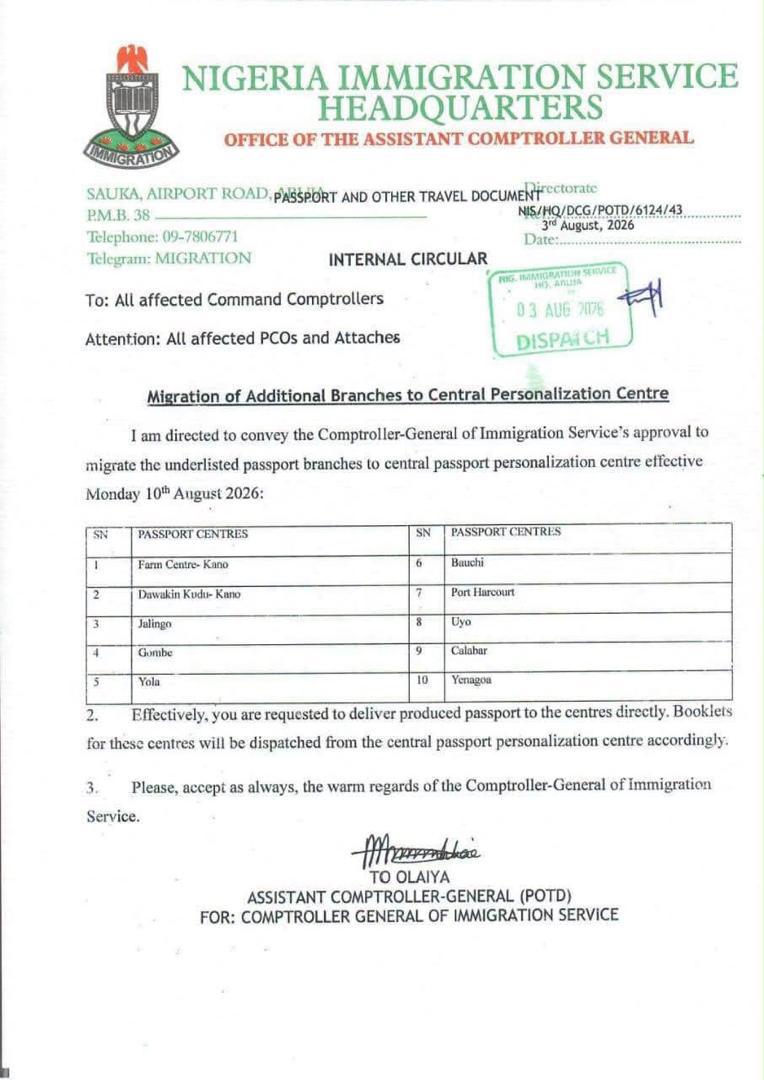
I am concerned about the recent decision by the Honourable Minister of Interior, Dr. Olubunmi Tunji-Ojo, to centralise passport production at the Nigerian Immigration Service Headquarters in Sauka, Abuja.
While the intention may be to improve efficiency and strengthen oversight, I believe this policy could create significant operational and security challenges.
Rather than centralising passport production, Nigeria should be moving towards greater decentralisation by strengthening regional passport production centres across the country.
At present, passports for Nigerians in Europe, as well as applicants from several states in the North, South-South, and North-East, are expected to be produced centrally.
This places enormous pressure on a single production facility and increases the risk of delays, technical disruptions, and logistical bottlenecks.
Given the current security challenges affecting parts of the country, concentrating such a critical national service in one location may also increase vulnerability. If the central facility experiences operational problems, technical failures, or security incidents, passport issuance nationwide and for Nigerians abroad could be seriously affected.
States such as Kano—which serves as a major commercial and administrative hub in Northern Nigeria—as well as Taraba (Jalingo), Adamawa (Yola), Gombe, Bauchi, Rivers (Port Harcourt), Cross River (Calabar), and Bayelsa (Yenagoa), among others, deserve efficient regional passport production services that reduce waiting times and improve accessibility.
I respectfully urge the Federal Government to review this policy and consider a decentralised passport production system. Regional production centres, operating under strict national standards and digital oversight, would improve service delivery, reduce processing time, strengthen resilience, and ensure that essential government services remain available even if one centre experiences disruptions.
A modern immigration system should be efficient, secure, resilient, and accessible to all Nigerians, both at home and abroad.
Decentralisation, supported by strong technology and effective supervision, would better serve these objectives than concentrating production in a single location.


