
Education
University certificates not yardstick for competence and capability..prof. obiora

|
Getting your Trinity Audio player ready...
|
University certificates not yardstick for competence and capability..prof. Obiora
By Umar Dankano Yola.
Nigerian academic institutions have been challenged to focus on training its students for capabilities, capacities and competence not certification which may not be commiserate with the knowledge acquired.
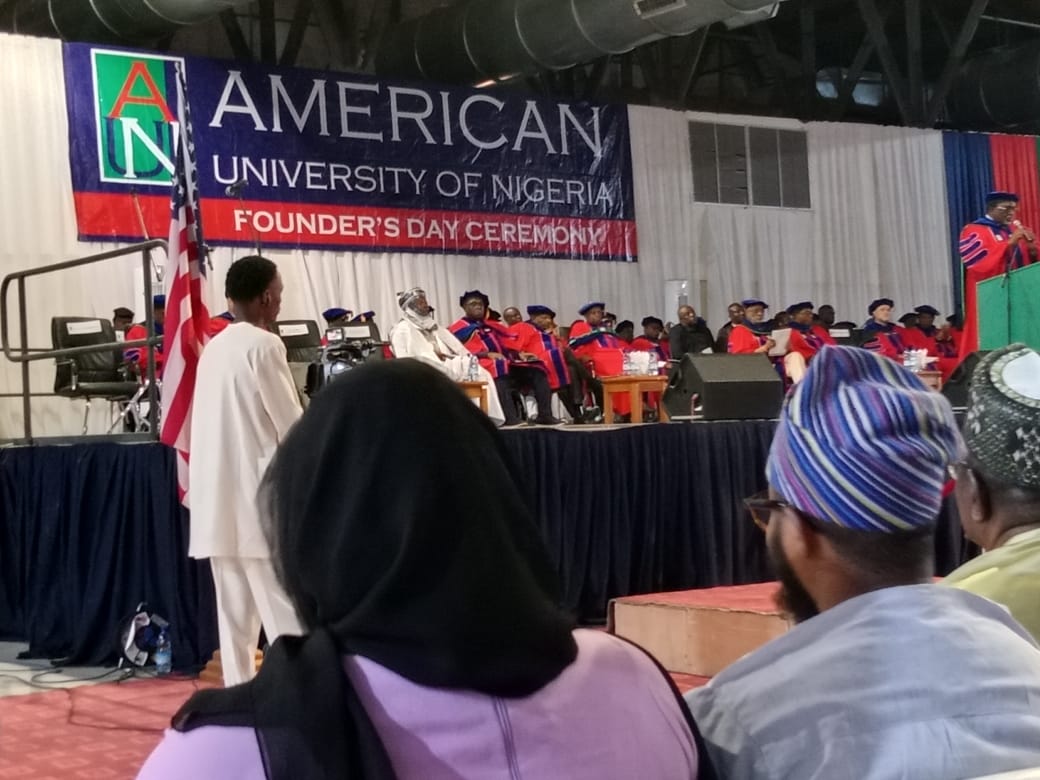
Executive chairman of the United Nigeria Airlines, Prof. Obiora Okonkwo threwn the challenge at the 18th Founder’s day ceremony of the American University of Nigeria,AUN Yola on Saturday stressing that a tertiary institution should measure its success by the capabilities it builds in students, not by the certificates it hands out.
Prof. Okonkwo, who served as a guest lecturer during the 2026 AUN’s Founder’s day ceremony presented a paper titled ;
“Purposeful Education and the 21st-Century University:Leadership,Innovation and Social Responsibility,”insisted that beyond certificates, a degree is only a starting point in academic learning.
In the paper,Okonkwo maintained that education is not an end in itself but a transformative process, and warned that paper qualifications can not be mistaken for competence. “A certificate may confirm the completion of a programme, but it cannot, by itself, guarantee the capacity to diagnose a problem,commun icate a solution, collaborate effectively, learn independently or exercise sound judgment under uncertainty. It is about gaining the knowledge that will take you to a higher place.
“Students must come to understand that education is not about getting certificate s.What you earn from this school should not only be enough for you to succeed as an individual, but should also be useful to society.
“The goal should be to produce a comple te education and a good citizen who can contribute to the development of the economy and of Nigeria as a whole”. Okonkwo said.
He called on students to be employers as well as job seekers, saying: “The measure of your education will not ultimately be determined by the prestige of your certificates or the positions you occupy, but by the value you create, the problems you solve, the opportunities you generate, and the lives you improve. The world does not merely need graduat es who understand its problems; it needs graduates who can imagine, design, and implement solutions to them.”
Okonkwo acknowledged that AUN is an international school offering an international curriculum, but said that status should be put to local use. He said he had not expected the institution to be so far along in the practices he was about to describe. “We should be able to adapt its presence to northeastern Nigeria. The opposition between ‘international’ and ‘local’ is ultimately false, as global excellence without local relevance can become institutional display,” he said.
He also addressed the region’s reputation, saying he had heard that many people held the wrong impression of the institution because of its location, and he rejected that view. Okonkwo praised the university’s practices and said he would back them with action. “I am happy to be here. I can see that this is a place many people have a wrong impression of because of its location. I am very glad to see that all of these things are already in practice here, so I commend them. I can tell you and everyone listening that next year I will send some students here on scholarship,” he said.
Okonkwo commended AUN’s founder, former Vice President Atiku Abubakar, whom he described as a visionary and an outstanding institution builder. He noted that the former Vice President’s role in the institution transcends those of an ordinary founder. Okonkwo also marked the founder’s recent milestone and prayed that he would live many more years, and in great vitality and vibrancy.
He ended his lecture by stating that the university’s future depends on whether it can carry its founding idea forward. “Yola is not peripheral to the world of knowledge. It is a site from which knowledge can be created, tested, shared and transformed.”
Earlier in his remarks,founder of the University and former Vice President Atiku Abubakar observed that in the global competitive space, human capital investment, technology innovation and artificial intelligence are the major priorities focused on which Nigeria must adopt and catch up with the rest of the world.
Represented by former Rivers state Gove rnor Rotimi Amaechi, Atiku declared that the country’s greatest national resource is its people, particularly its young population emphasizing that Nigeria’s future would depend largely on its ability to educate, equip, employ and empower its citizens to compete in an increasingly technology-driven global economy.
In his address, titled “The Future We Choose: Human Capital, Artificial Intelligence, and Nigeria’s Renewal,” Atiku maintained that the country’s development challenge was not necessarily a shortage of talent, but its failure to consistently develop and deploy the enormous human potential available to it.
He stressed the need for Nigerian solutions to Nigerian problems, identifying opportunities for technological applications in agricultural productivity, education in underserved communities, public healthcare, electricity, clean water and the expansion of small businesses.
According to him, the quality of the country’s human capital, rather than the abundance of its natural resources, will ultimately determine its economic competitiveness and national prosperity.


